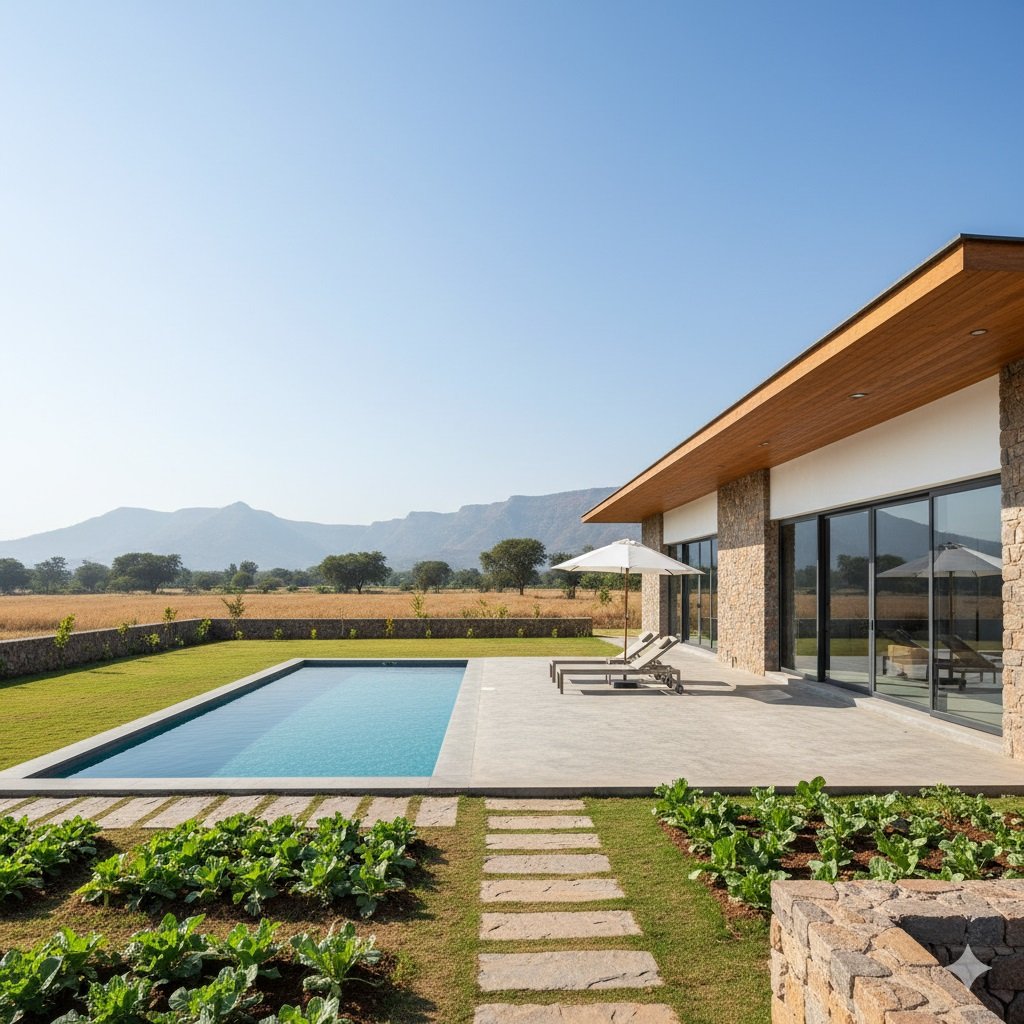
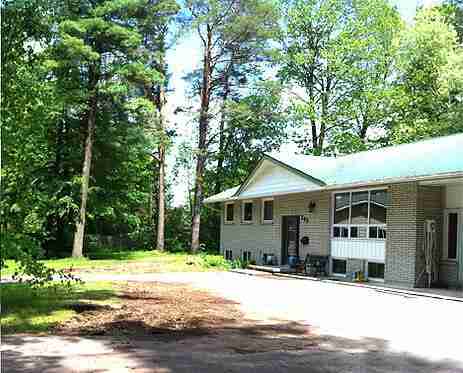
Here is a general price range, based on current listings:
Farm Land (Raw land or Gated community plot)
Price Per Square Yard:
So, in the case of gated communities, depending on the location and features, it would generally range between ₹6,000-7,500 per square yard to even as high as ₹8,000 – ₹10,000 per square yard or higher for premium locations (with Aravalli views or better accessibility).
Open but not gated agricultural land can be cheaper, as low as ₹3,500 – ₹5,000 per square yard.
Total Plot Price (Example Sizes):
A smaller lot (for example, 1250 sq. yards ( in a gated community ) may begin from ₹80 Lakhs to ₹1.0 Cr.
Bigha Several acres or the number of Bighas available. yards) in semi developed, gated communities can be as low as ₹1.5 Crores.
Built-Up Farm Houses (Villas/Homes)
The ready to move or under construction farm houses can fetch a premium too, as per the built up area and luxury level.
2 BHK as wellas 4 BHK built up Farm houses are available in the following ranges.
₹81 Lakhs to ₹1.41 Crores for the size range of (1250 sq. yards to 1 Bigha in plot sizes with a house constructed on it.
On the other hand, a luxury or an extremely large farmhouse can be priced for ₹1.60 Crores and above as well ranging upto ₹2.0 Crores etc
Note: These are not accurate/ fixed prices, these are just an estimate. Prices mentioned above are the best (least) price available for each item across all stores. Price lists herein can be very helpful, but to know the exact and most up to date prices of property in Naugaon, it’s always better to esquire on site ( you may contact real estate agents or developers in Naugaon for their travel plan) or simply give us a call 🙂
Below is a detailed extraction including per unit budget and project wise cost, focusing mainly on farm plots in gated communities as it seems to be the most sought after.
Farmhouse Plot Price (INR Per sqr. yard)
The rate per square yard in Naugaon depends primarily on whether the plot is in a managed, gated complex with amenities and its distance to the highway or Aravalli views.
Property Type / Location Approximate Price Range (Per Sq. Yard)
Gated Community (Standard Plot) ₹6,000 to ₹7,500
Premium Gated Community (Aravalli views, better access) ₹7,500 to ₹10,000
Open Agricultural Land (Non-gated, basic) ₹3,500 to ₹5,000
Ready-to-Move (RTM) Plot (Often developed with basic infrastructure) ₹10,000 to ₹12,000+
2. Total Investment Cost (By Plot Size)
The most plots common sizes are 1250 sq. yards, 1500 sq. yards, and 1 Bigha (approx. 3025 sq. yards).
Plot Size (Approximate) Total Estimated Price (Gated Community)
1250 Sq. Yards ₹80 Lakhs to ₹1.25 Crores
1500 Sq. Yards ₹90 Lakhs to ₹1.35 Crores
1 Bigha (3025 Sq. Yards) ₹1.5 Crores to ₹2.11 Crores
2 Acres (Approx. 9680 Sq. Yards) ₹2.25 Crores to ₹2.7 Crores
Note: These are plot rates for a developed farm community and usually cover the price of common facilities like internal roads, water, security etc. Admission prices for a plot with a built house are more expensive.
3 Price Examples from Specific Projects
There are several gated farmhouse projects on Naugaon, everything from essential plots empirically have established their entry-level price:
Project Name (Developer) Plot Size (Sq. Yards) Starting Price (Total) Starting Price (Per Sq. Yard)
RPS Sargam Farmland (Rudrom Group) Starts from 1265 Sq. Yd. ₹80 Lakhs Approx. ₹6,300
JBMR Cloverdale Farms (JBMR Group) 1500 Sq. Yd. ₹85.05 Lakhs Approx. ₹5,670
RASA Estate Farms New Launch/Ongoing on Call Approx. ₹6,500
Elevate Samava Farms New Launch/Ongoing on Call Approx. ₹7,500
Built-Up Farm Houses (Villa/Home)
Farm houses that are pre-built or part of a villa project, pricing sunders the built up area and rooms (BHK).
Configuration Approx Price Rental 2 BHK Farm House ₹87.55 L – ₹1.30 Cr typically plots of 1216-1500 Sq. Yds. 3 BHK Villa / Farm House₹90 Lakhs – ₹1.76 Cr On Exclusive Luxury housings. 4 BHK Farm House₹1.08 Cr. to ₹1.39 Cr. Example: Pacific Hill Front Farms.
Important Considerations for Buyers:
CLU/Legal Status: Always confirm the CLU approval and legal title, as numerous developers advertise property with CLU approved plots for construction of farmhouses.
Location: Plots near the Delhi-Mumbai Expressway and with a clear view of Aravalli hills are priced highest.
Amenities: “The fancier the amenities — private pools, clubhouses, high-level security and the like — the higher they’ll go on costs.”
https://realtyhunting.com/naug....aon-farm-house-price