A well-designed website is one of the most important parts of a successful online presence. Whether it is a business website, e-commerce store, personal portfolio, or blog, every website needs a clean layout, easy navigation, and a good user experience. This is where web designing skills become important.
A Web Designing Course can help beginners and working professionals learn how websites are planned, designed, developed, and improved for different devices. With practical learning, students can understand how to create attractive and user-friendly websites without getting overwhelmed by technical concepts.
What Is a Web Designing Course?
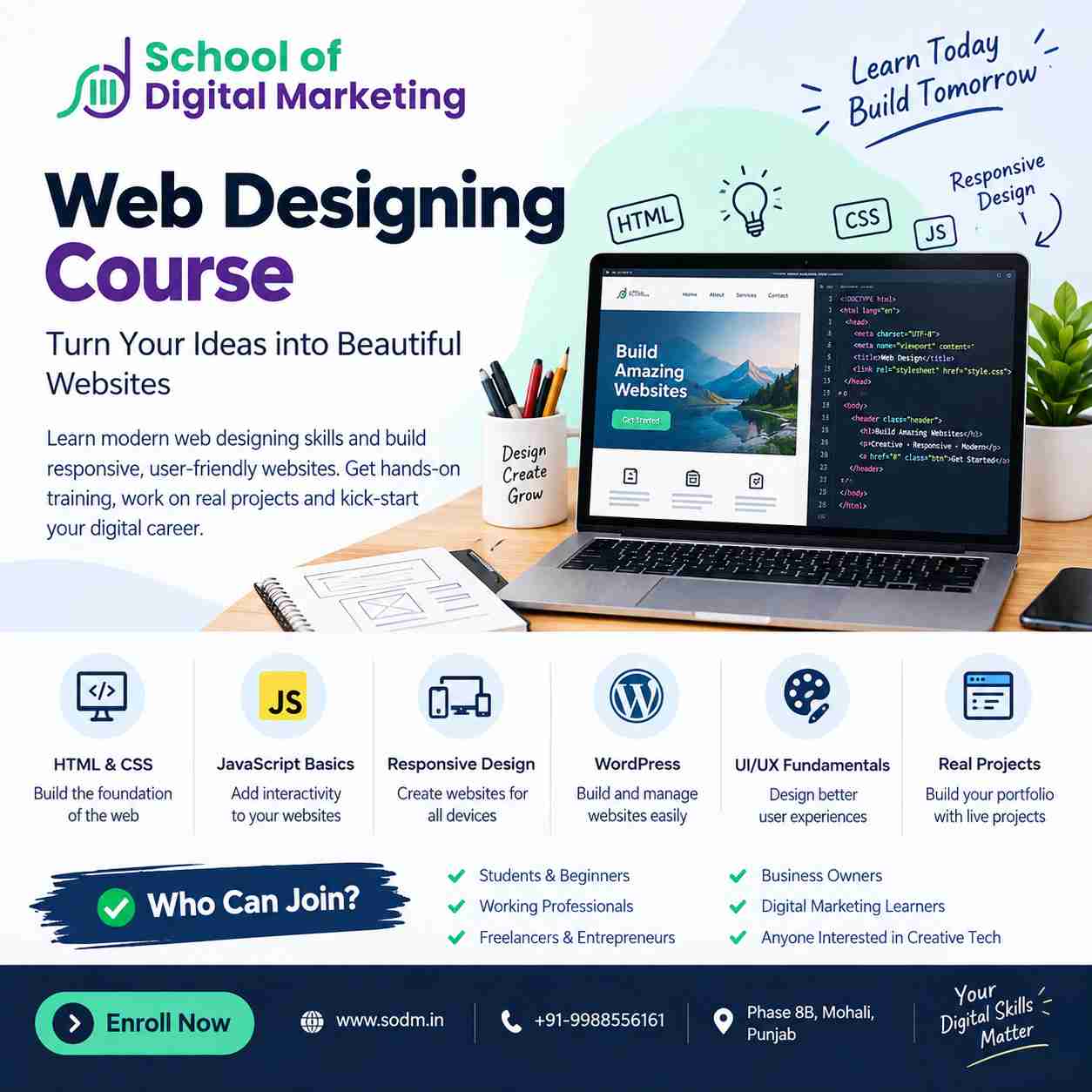
A Web Designing Course is a training program that teaches the fundamentals of creating and designing websites. It usually covers website structure, page layouts, responsive design, typography, images, navigation, user experience, and basic front-end technologies.
Depending on the course level, students may learn tools and technologies such as:
HTML
CSS
JavaScript basics
Bootstrap
WordPress
Responsive web design
UI/UX fundamentals
Website design tools
Basic SEO for websites
The goal is not only to learn how a website looks but also to understand how different design elements work together to create a useful digital experience.
Why Learn Web Designing?
Websites are used by businesses, educational institutions, startups, freelancers, professionals, and almost every industry. This creates a need for people who understand website design and front-end development.
Learning web designing can help you:
Build websites from scratch
Create responsive web pages
Understand modern design principles
Develop personal and business websites
Create a professional portfolio
Work on freelance website projects
Improve your digital marketing skills
Explore careers in web design and front-end development
Web designing is also useful for digital marketers because a website plays an important role in SEO, social media marketing, paid advertising, and online branding.
What Will You Learn in a Web Designing Course?
A good course should combine concepts with practical assignments. The exact syllabus may vary, but beginners generally start with the basics and gradually move toward real website projects.
1. HTML
HTML provides the basic structure of a webpage. You can learn how to create headings, paragraphs, links, images, lists, forms, tables, and other page elements.
2. CSS
CSS is used to control the appearance of a website. It helps you work with colors, fonts, spacing, layouts, backgrounds, borders, animations, and other visual elements.
3. Responsive Web Design
People access websites through smartphones, tablets, laptops, and desktop computers. Responsive design helps a website adjust properly to different screen sizes.
4. JavaScript Basics
JavaScript can make websites more interactive. A beginner-level course may introduce concepts such as buttons, menus, sliders, pop-ups, form validation, and basic dynamic functionality.
5. WordPress
WordPress is widely used for creating websites without building everything from the ground up. Students can learn themes, pages, menus, plugins, layouts, and basic website customization.
6. UI/UX Fundamentals
Good design is more than attractive colors and images. UI/UX concepts help students understand navigation, readability, user behavior, page structure, and overall website usability.
7. Website Projects
Practical projects are an important part of learning. Students may create websites such as:
Business websites
Portfolio websites
Landing pages
Blogs
Service websites
E-commerce layouts
These projects can also become part of a professional portfolio.
Who Can Join a Web Designing Course?
A Web Designing Course can be suitable for different types of learners, including:
Students
Beginners
Graduates
Freelancers
Entrepreneurs
Digital marketing learners
Working professionals
Business owners
People interested in creative technology
You do not necessarily need an advanced technical background to begin. Basic computer knowledge and an interest in website creation can be enough for a beginner-level course.
Is Web Designing Difficult for Beginners?
Web designing can look complicated when you see code for the first time, but it becomes easier when concepts are learned step by step.
HTML helps you understand the structure of a webpage, while CSS controls its appearance. After learning these fundamentals, you can gradually move toward responsive design, JavaScript, WordPress, and other technologies.
Regular practice is more important than trying to learn everything at once.
Career Opportunities After Web Designing
After gaining practical skills, learners can explore different career paths depending on their knowledge and experience.
Some possible roles include:
Web Designer
Junior Web Developer
Front-End Developer
WordPress Designer
UI Designer
Website Administrator
Freelance Web Designer
The career path can also expand when web designing is combined with skills such as SEO, digital marketing, graphic design, or content creation.
Web Designing and Digital Marketing
Web designing and digital marketing are closely connected. A digital marketing campaign often sends visitors to a website or landing page. If that page is slow, confusing, difficult to use, or poorly designed, visitors may leave without taking action.
Understanding web design can help digital marketers create better landing pages, improve website usability, and communicate more effectively with developers and designers.
For this reason, learning web design can be a valuable additional skill for someone pursuing a career in digital marketing.
How to Choose the Right Web Designing Course?
Before joining a course, look beyond the course title. Check what you will actually learn and how much practical training is included.
Consider these factors:
Practical Training
Choose a program that includes hands-on assignments and website projects instead of only theoretical lessons.
Updated Syllabus
Web technologies and design trends change regularly. Check whether the syllabus includes modern responsive design and commonly used tools.
Portfolio Development
A portfolio can help demonstrate your skills to potential employers and clients. Look for training that allows you to work on multiple projects.
Trainer Support
For beginners, the ability to ask questions and receive feedback can make learning much easier.
Course Duration
Choose a duration that matches your learning goals and available time. Avoid selecting a course only because it is shorter.
Frequently Asked Questions
What is a Web Designing Course?
It is a training program that teaches students how to plan, design, and create websites using technologies and tools such as HTML, CSS, JavaScript, WordPress, and responsive design techniques.
Can beginners learn web designing?
Yes. Beginners can start with basic HTML and CSS and gradually learn more advanced concepts through regular practice.
Is coding required for web designing?
Basic coding is useful for professional web designing, particularly HTML, CSS, and JavaScript. However, tools such as WordPress can also help beginners create websites with less coding.
How long does it take to learn web designing?
The learning time depends on the course structure, your previous knowledge, and how regularly you practice. Basic concepts can be learned relatively quickly, while professional-level skills require continued practice and real projects.
Can web designing be used for freelancing?
Yes. Skilled web designers can offer services such as business website design, landing page creation, WordPress customization, and website maintenance to clients.
Is web designing useful for digital marketing?
Yes. Knowledge of web design can help digital marketers understand landing pages, website structure, user experience, conversion elements, and basic technical SEO.
Start Learning Web Designing
Web designing combines creativity with technical skills. Instead of focusing only on theory, learners should practice by creating real webpages and complete websites.
If you are starting from zero, begin with HTML and CSS, understand responsive design, practice with different layouts, and then move toward JavaScript, WordPress, UI/UX, and other relevant skills.
A structured Web Designing Course can provide a clear learning path and help you build practical skills that can be used for employment, freelancing, personal projects, or business websites.visit us - https://sodm.in/courses/web-designing